
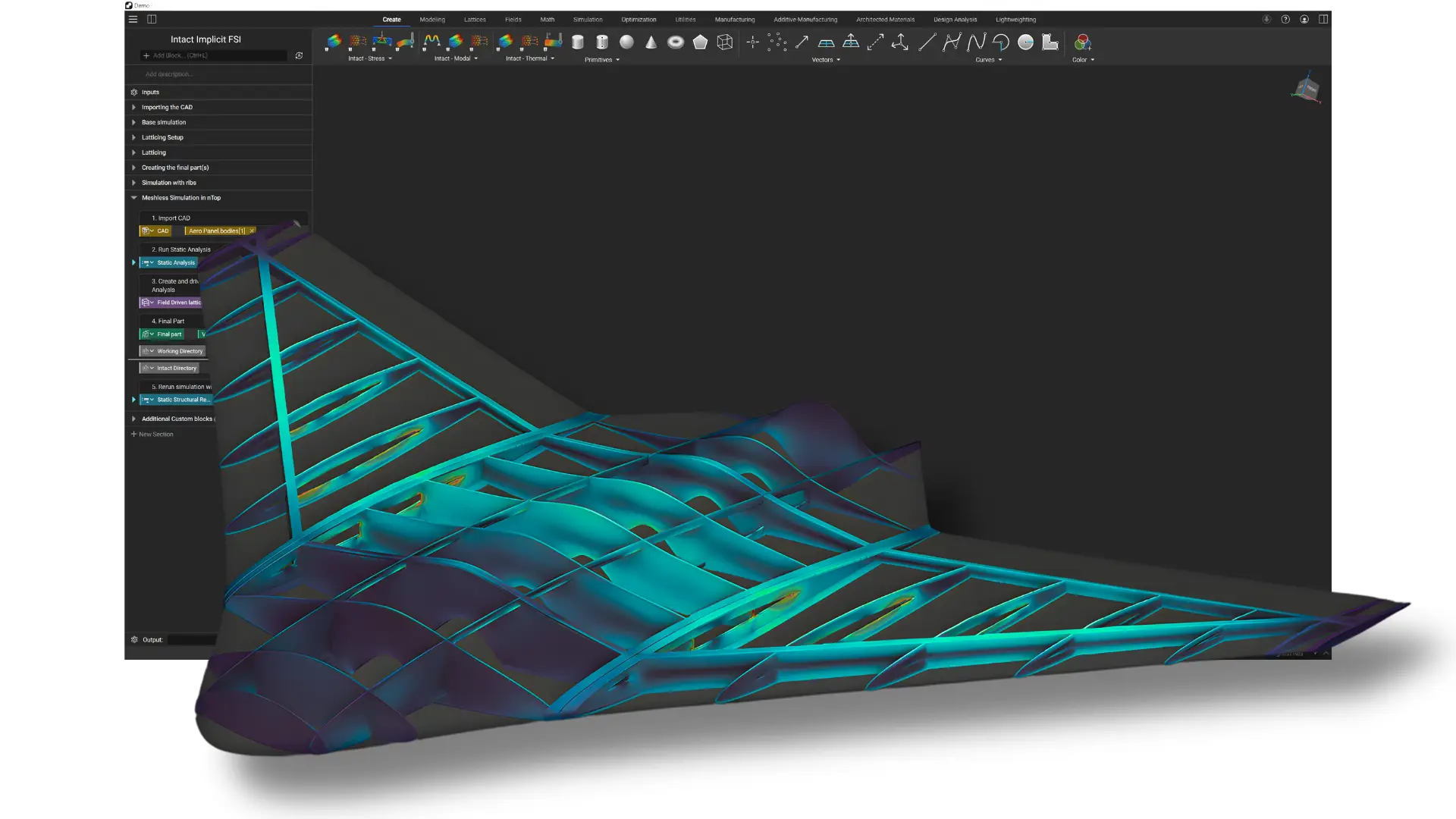
WHAT'S NEW IN INTACT.SIMULATION FOR NTOP V2.0
This release adds new physics, assemblies, loads and brings Intact directly into the nTop Connector.
IN THE NTOP INTEGRATION
- Accessible via the nTop Connector tab
- Preview simulation setup before hitting go
- Native nTop blocks for geometry, materials, and boundary conditions
EXPANDED ANALYIS
- Modal and thermo-mechanical analysis
- Native .implicit support
- Anisotropic (orthotropic) materials and bonded multi-material assemblies
- Remote (flexible) loads, spatially varying pressure fields, and inertial relief
NATIVE PHYSICS FOR NTOP
nTop gives engineers a powerful way to create lattices, graded structures, field-driven features, organic transitions, and other highly parameterized designs. Intact.Simulation for nTop brings engineering physics into that same implicit workflow, so the geometry created for design can also be used for analysis.
Instead of rebuilding an implicit model as an explicit surface and then generating a body-fitted volume mesh, engineers can evaluate the native design directly. That reduces analysis-specific geometry preparation and makes simulation practical while the design is still changing—not only after it has been simplified and frozen.
The result is a tighter connection between design and physics: complex geometry can be tested earlier, changed more freely, and evaluated repeatedly without turning every iteration into a new preprocessing project.
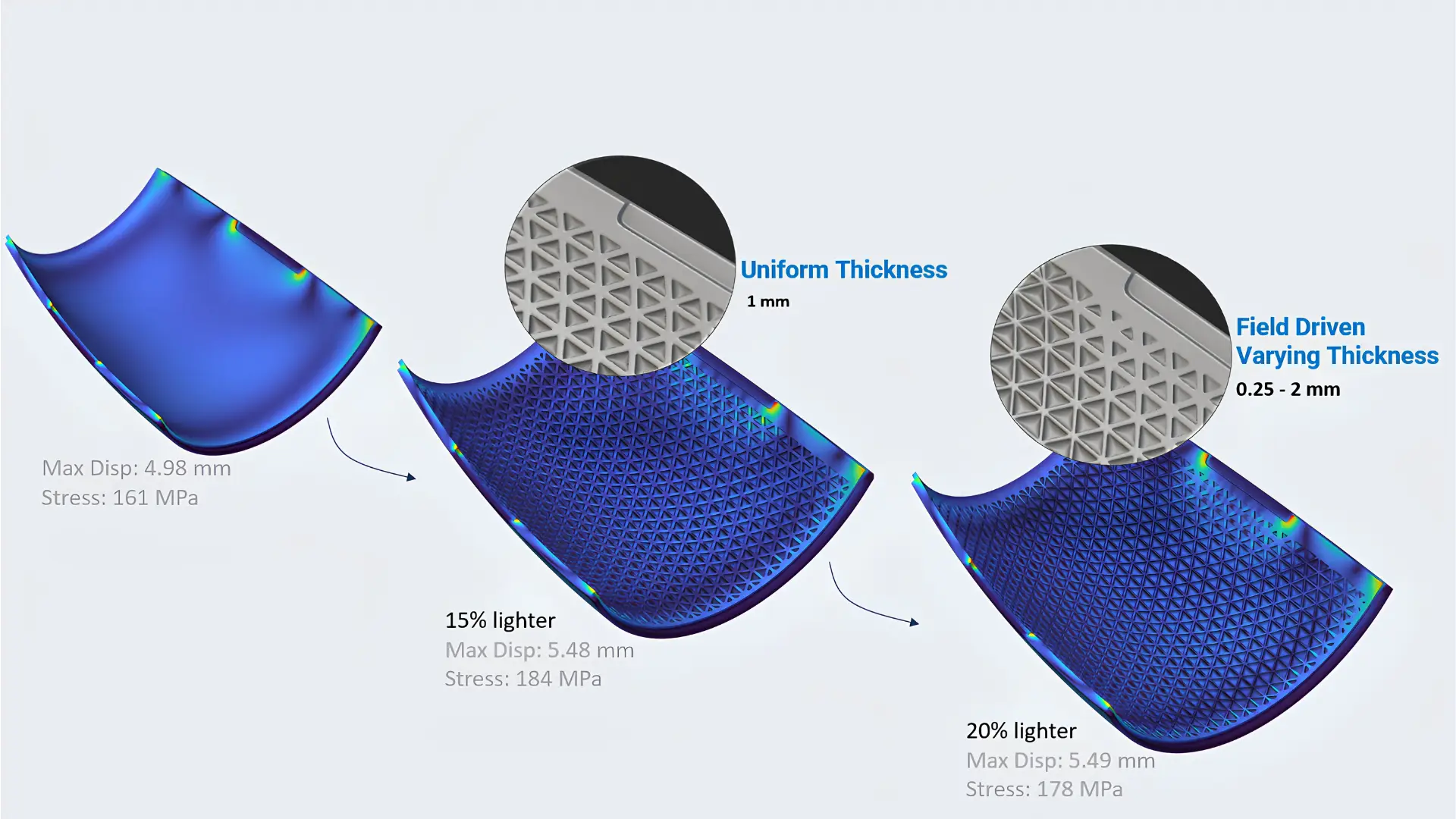
Analyze field-driven nTop designs without rebuilding them as analysis-specific geometry.
WHAT IT IS
Finite-element analysis that works with the native implicit
Intact.Simulation for nTop is an immersed finite-element analysis product built for nTop workflows. It accesses native implicit geometry through nTop Core and places the design in an independent finite-element grid. Because the grid does not have to conform to every rib, lattice member, gap, or topology change, the body-fitted meshing process is eliminated.
Once the analysis grid, geometry integration, and boundary conditions are established, the remaining process is classical FEA: assemble, solve, and post-process. Engineers can control the analysis resolution, use coarse studies for early directional feedback, and refine the grid when greater accuracy is required.
WHAT IT CAN ANALYZE
Engineering capabilities for computational design
Intact.Simulation for nTop combines the physics needed for common engineering decisions with geometry and workflow support designed for computational modeling.
01
Physics
- Structural stress and displacement
- Thermal analysis
- Modal analysis
- Thermo-mechanical analysis
02
Models and loading
- Native pure implicits, plus VDB and surface-based geometry
- Isotropic and orthotropic materials
- Bonded multi-material assemblies
- Standard, body, remote, and spatially varying pressure loads
- Loads and restraints selected directly on pure implicit surfaces
03
Connected workflows
- Coarse-to-fine analysis resolution
- Pressure and temperature fields from nTop Fluid
- Headless execution with nTop Automate
- DOE, optimization, Python, and ML-driven design loops
WHAT IT ENABLES
Keep physics inside the implicit workflow
Analyze geometry that cannot be easily meshed
Lattices, dense ribs, small gaps, graded structures, and large variations in feature scale can make conventional meshing difficult or impractical. Intact.Simulation evaluates these models in their native representation, allowing engineers to preserve the features that give the design its performance instead of removing them to satisfy a mesher.
Bring physics into design iteration
Parameters, fields, and topology can change in nTop without requiring a new analysis-specific surface conversion and body-fitted mesh for every candidate. Simulation can therefore inform the design while it is being generated. Engineers can compare alternatives, identify promising directions, and refine performance without interrupting the implicit workflow.
Scale from one analysis to a design workflow
A repeatable analysis process can extend beyond a single model. nTop Automate can generate design candidates, Intact.Simulation can evaluate them headlessly, and Python or ML tools can use the results to guide the next set of parameters. The same native connection can also transfer pressure and temperature fields from nTop Fluid into structural, thermal, and thermo-mechanical studies without an intermediate mesh-transfer workflow.
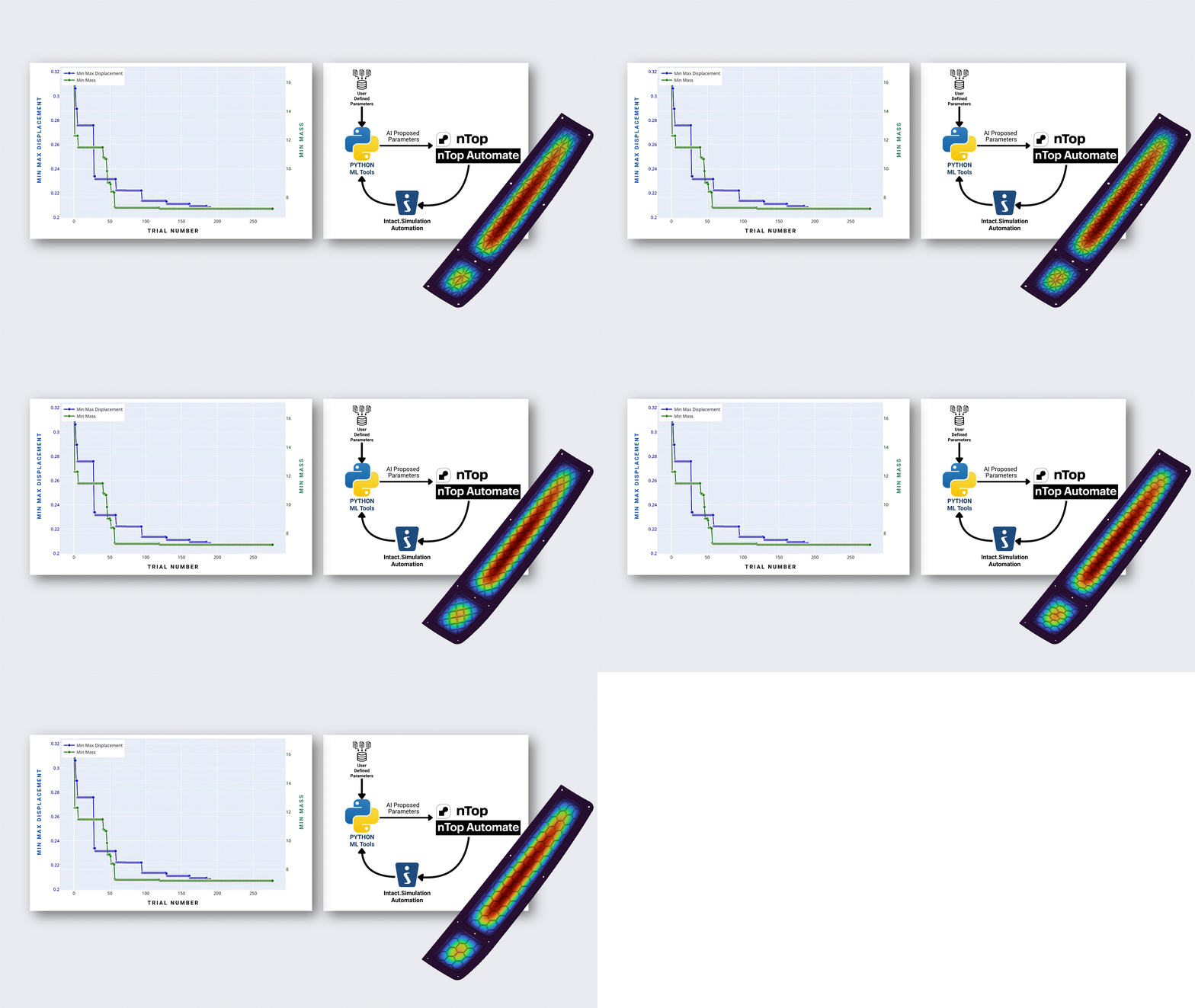
Generate designs in nTop, evaluate them with Intact.Simulation, and use the results to drive the next design decision.
Want to see how native implicit simulation works?
See how Intact integrates implicit volumes, applies boundary conditions directly on implicit surfaces, and converges against mesh-based FEA.
Contact Intact to discuss an nTop model or workflow.