

The Bottleneck in Simulation
Engineers and computational designers are pushing toward automation, AI, and large-scale design space exploration. Yet, traditional FEA tools remain tied to meshing, a fragile and manual step that breaks automation pipelines. While some FEA tools offer APIs, they remain clunky, file-heavy, and not designed for AI-era workflows. There is a better way, as shown in Figure 1.
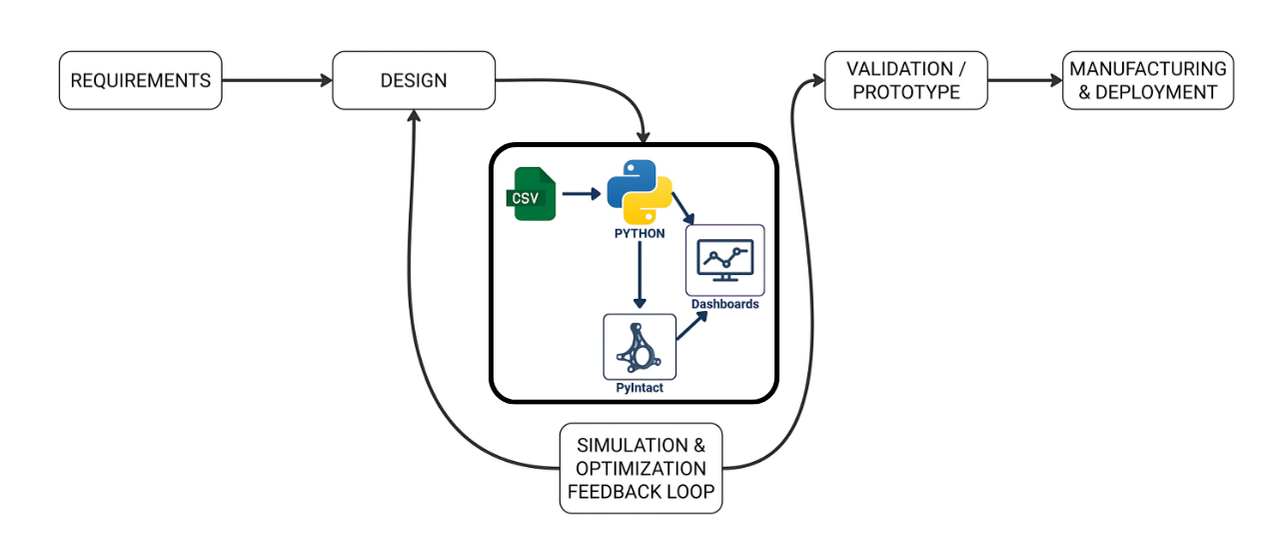
Figure 1: Diagram of Engineering workflow with Simulation and Optimization feedback loop
Introducing PyIntact
PyIntact is the Python API for Intact.Simulation, our meshfree FEA and optimization engine. It was born out of customer demand for a flexible, headless, and automation-friendly interface. With PyIntact, engineers can run simulations entirely in Python without GUIs or meshing hassles, keep data in memory for efficient interop with NumPy, SciPy, and ML frameworks, and deploy across laptops, servers, and clusters on both Windows and Linux. Perhaps most importantly, PyIntact provides access to both Intact.Simulation (structural, thermal, buckling) and LevelOpt (topology optimization) from a single API.
Rather than replacing existing tools, PyIntact connects directly to them. It becomes the invisible engine behind workflows in nTop, Grasshopper, Houdini, or custom pipelines. The result is simulation that feels as fluid and programmable as any other step in computational design.
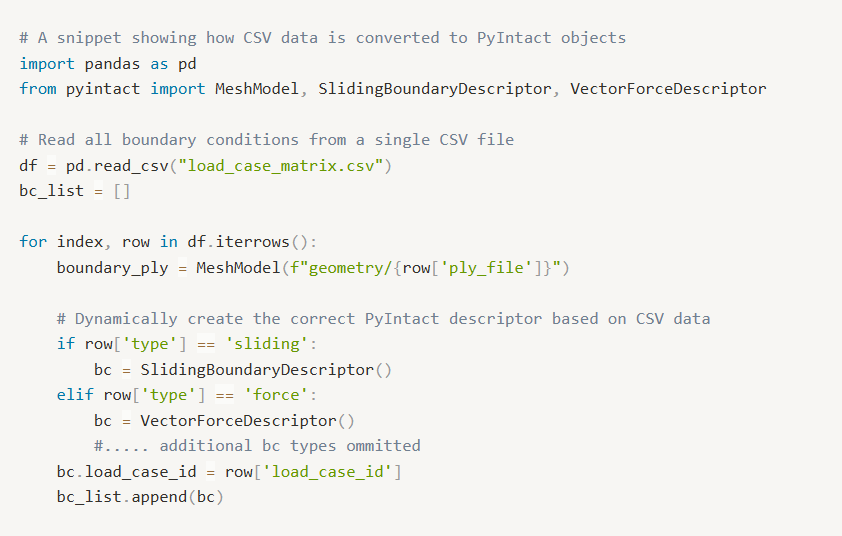
Figure 2: PyIntact code snippet
Why PyIntact is Different
Traditional FEA APIs were designed in a different era. They assume an engineer will carefully prepare a mesh, manually fix problems, and run only a handful of cases at a time. Automation is often bolted on as scripting, which tends to be brittle when geometry changes or when workflows must scale. PyIntact, by contrast, was built for automation first. Its meshfree engine means there is no meshing step to fail. Its Python-native design means data moves seamlessly between PyIntact and the broader scientific ecosystem. And because simulation and optimization live side by side in one interface, workflows like DOE, multi-load optimization, and AI dataset generation come naturally.
Here’s how that difference plays out in practice:
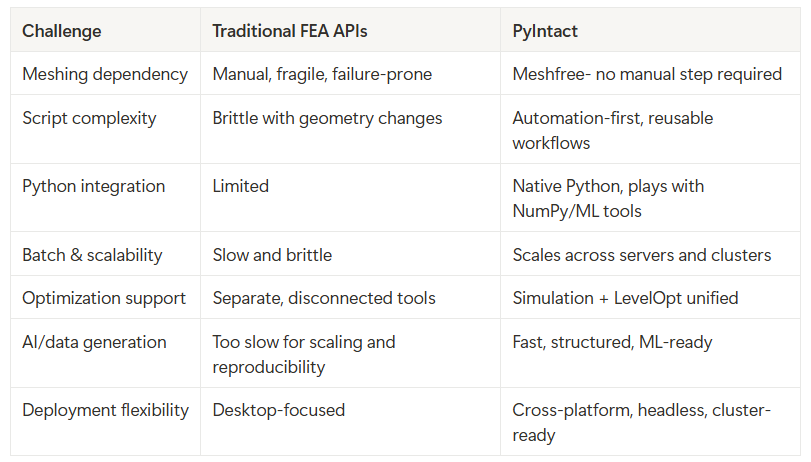
Taken together, these differences highlight why PyIntact isn’t just an incremental improvement. It represents a shift in how simulation can be embedded directly into automated, modern design workflows.
What You Can Do With PyIntact
When engineering iteration is quick and cheap, you don’t just find a design – you discover the best design. The real power of PyIntact becomes clear when looking at what engineers actually accomplish with it. Instead of wrestling with meshing, they:
- Set up large DOE studies and run hundreds of design variants overnight.
- Perform multi-load case optimization, even with more than ten load cases, without tedious manual setup.
- Generate AI-ready datasets quickly, consistently, and in structured formats.
- Plug PyIntact into tools like Houdini and Blender, treating simulation as just another Python library.
In other words, PyIntact allows engineers to focus on exploration and insight rather than setup and troubleshooting.
Figure 3: Design iteration progression across 7 volume fractions and per-iteration compliance, von Mises stress, and max displacement for one load case (emergency braking with tow) is shown.
Modelab’s presentation at Houdini Hive, Siggraph 2023, Building a pipeline of advanced material systems in Houdini with Intact.Simulation for Automation (V1.0 – before PyIntact)
Customer Workflows
Customers are already proving the concept. In one study, PyIntact powered hundreds of simulations in just hours when paired with nTop Automate, something that would have taken days or weeks with traditional meshing-based FEA (Figure 4). In another, LevelOpt and PyIntact were combined to perform multi-load topology optimization at scale, showing that optimization and automation can coexist seamlessly in one environment as shown in Figure 3.
These examples are only the beginning, and they illustrate how PyIntact can scale from proof-of-concept explorations to production-ready pipelines.
Figure 4: Large scale DOE with nTop Automate and PyIntact completed in hours instead of weeks
The Bigger Picture
PyIntact is the gateway to AI in engineering. It’s not just another API bolted onto an old solver. It is the foundation of a new paradigm in the age of AI: meshfree, Python-native, and built for scale. By making simulation callable from anywhere in your workflow, PyIntact enables automated pipelines, computational design, and AI agents that explore and optimize designs autonomously.
In this vision, simulation isn’t a bottleneck—it is the engine that unlocks limitless design exploration and accelerates the outcome faster.
PyIntact is available now with Intact.Simulation for Automation. Explore the PyIntact docs, try it in your workflow, and reach out—we’d love to see what you build.
